martedì 17 settembre 2013

Jennifer Boulay

Inside to the Colosseum. September 13, 2013. Shutter Speed: 1/4000. F-stop: 5.6. I really like the composition and lighting of this picture. I like all the lines and patterns that this picture is composed of.

Savanna.  Shutter Speed: 1/3200 and F-stop: 5.6. This picture is under exposed but i really liked the pose she did and how you can follow the angles and lines of her body with the angles of everything around her.


Martine Franck
FRANCE. Clamart. Library for children. Built by the "Atelier de Montrouge": Jean Renaudie, Pierre Riboulet, Gerard Thurnauer and Jean-Louis Veret. Ile de France. Haut de Seine. 1965.
I really like the motion of this picture how you can see the spiral to the ceiling with all the kids faces peering over the side of the stairs. I also love how it was done in black and white because it gave off a different mood rather than if it was done in color. The childrens facial expressions are also interesting because they are all different and they are more serious. So it gets you thinking about what they are thinking about and what they are trying to do.

RAW vs JPEG

JPEG – JPEG files are processed right within the camera. How exactly they are processed varies from model to model. While color temperature and exposure are set based on your camera settings when the image is shot, the camera will also process the image to add blacks, contrast, brightness, noise reduction, sharpening (which you can see in the example above) and then render the file to a compressed JPEG. These files are finished and can be viewed and printed immediately after shot.

RAW – RAW files are uncompressed and unprocessed snapshots of all of the detail available to the camera sensor. Because RAW files are unprocessed, they come out looking flat and dark. RAW images need to be viewed and processed using your camera’s software or in more robust commonly used software like Adobe PhotoshopLightroom, Aperture, etc prior to being ready for display or print.

CCD vs CMOS

CMOS and CCD image sensors convert images (light) into electronic signals. CCD sensors are slightly cheaper and are the older, more mature technology. CCD and CMOS sensors are susceptible to different problems — CCD sensors are more susceptible to vertical smear from bright light sources, while CMOS sensors are susceptible to skewing, wobbling and partial exposure. However, neither technology is a clear winner over the other in over all image quality.

CCDs use a global shutter, which exposes the entire image simultaneously. This can lead to blur if any motion occurs in the image during exposure, but a high shutter speed prevents this problem.
CMOS sensors are equipped with “rolling shutters,” which expose different parts of the frame at different points in time. This can lead to skew, wobble and partial exposure in photographs.

Kristen 9/18/13 Post

Photos:
Taken at lunch at 1:00 PM. Dolceforte. ISO 1000. Shutter 1/80. F/4.
Looks slightly underexposed.

La bella Julia in Montalcino. 6:30 PM. ISO 200. Shutter 1/200. F/7.1.

Digital Sensors (CCD & CMOS):
Digital sensors are a component of digital cameras that capture light and convert it into electrical signals. The basic mechanism behind the sensors is that light hits the chip and is held as a small electrical charge, which is then converted into voltage, and is ultimately converted into digital information. CCD or "charge-coupled device" sensors convert the charge to voltage one pixel at a time. This type of sensor is used for high-quality image data such as in medical & scientific applications & captures the image all at once. Some cons of a CCD are that they are much more expensive & are susceptible to vertical smear from bright light when overloaded. CMOS or "complementary metal-oxide semiconductor" sensors are an active pixel sensor that captures a row at a time and uses different circuitry. Pros include: cheaper, no vertical smear, use less power, faster readout. However, CMOS sensors can result in "rolling shutter," which can cause slightly skewed images.

RAW vs. JPEG:
RAW photos contain all the information that can be taken in by the camera, however, they are much larger files and require significant post-processing. JPEG files are more compressed than RAW, but generally require little to no processing.
Using JPEG File format

Using RAW
Photo Description:
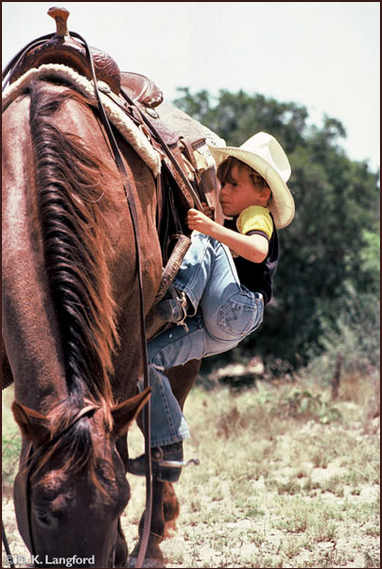
This photo is by David K. Langford. I love how the horse is in the left side of the frame and how his mane draws a beautiful line calling attention to the top of the saddle all the way to the bottom of the frame. The boy's arms and legs have strong angles that give more complexity to the photo. 


lunedì 16 settembre 2013

Grace photo

This photo, taken in the cinque terre, overlooks the view between Vernazza and Monterosso.  The photo was taken with the following settings: ISO:125, 1/500, F4.0

This photo is taken from the top of Vernazza and depicts the view looking south.  The photo was taken with ISO 640, F.8, and 1/2500

CCD vs CMOS--Grace

CCD and CMOS are two kinds of image sensors in a camera, however both have their advantages/disadvantages.

CCD sensors have higher image quality and cleaner images.  The colors tend to be more saturated and vibrant.  These sensors respond better to low light situations.

CMOS are more efficient and consumer friendly.  They consume only a fraction of power that CCD sensors use and are incredibly inexpensive.  CMOS cameras therefore are cheaper to buy and use, but take lower quality photos.

JPEG vs. RAW files--Grace

A Raw file from a camera takes a photo that is uncompressed, and therefore larger than a JPEG file.  A raw has a higher dynamic range, less sharpness, and lower in contrast.  A raw file needs to be processed by your computer before it can be printed.  However, since the file is so large, all the details are captured.  This allows you to easily manipulate the photo using your computer.

JPEG, on the other hand, is readable by most programs, as it is a standard format.  These files are small in size, lower in dynamic range, and sharper.  In this format, you can take more pictures on your camera, and read the image on your camera.

Magnum photo by Leonard Freed--Grace

This picture, taken by Leonard Freed depicts Martin Luther King on his return to Baltimore, Maryland in 1963.  The photo has a positive and warm tone, reflected in the energy and the smiles of the people involved.  The juncture of the hands create a focal point and the arms radiate outward, drawing the eye to all corners of the photograph.
-Grace

domenica 15 settembre 2013

Elisabeth

Sergio Mottura- Vineyard
Civitella D'Agliano, Lazio, IT
September 13, 2013; 2:47pm
ISO 100, 27.6mm, f/6.3


 Newsstand on 42nd Street.
USA. New York City. 
August 14, 2003.
Photo by: Ilkka Uimonen

CCD and CMOS are image sensors in digital cameras.
CCD creates high quality images with low noise and is very sensitive to light.
CMOS are generally higher in noise and transfer pixels differently.  Cameras with CMOS also use less battery. 


venerdì 13 settembre 2013

If you need equipment


Wed 18 - after the first hour in class we will move to the Orto Botanico
 

Wed 25 - Meeting point at the MAXXI MUSEUM to visit the museum and the wonderful exhibition of the Italian photogrpher LUIGI GHIRRI


Further informations will be post in the class blog.

Sebastao Salgado -- Exhibition - ROme- Last two days!!!!!

Dear students, I strongly recommend you to visit this exhibition.
It is really, really interesting.
Last day Saturday!!


mercoledì 11 settembre 2013

afnan


 rome via della lungara mobile 

Melisa

Taken in Montepulciano, Sept. 15. Shutter speed 1/2. ISO 160 f3.5 aperture
The difference between jpeg and raw pictures is you have more control over how the image will come out in raw pictures because you can adjust the color/contrast/saturation.

Guy Le Querrec
FRANCE. 1973. Paris. 14th-15th arrondissement. Boulevard de Vaugirard. Place Bienvenue.
Taken in Rome, Sept. 9. Shutter speed 1/60. ISO 200. f14 aperture

Abbas
MALI. Bakodijikorone. 1994. Children imitating the photographer.

In CCD sensor, all colors are active. In CMOS only one color can transform into electricity.


Lawrence


Statue of Jesus, Vatican City


Guy Le Querrec, French 1941


CCD vs CMOS 

Zeyneep


Rome musicians playing, 07.09.2011


Christopher Anderson, BRAZIL. Rio de Janeiro. 2009. Marion and Atlas in the shower.


CCD Sensor

Marta

 Rome, 9/10/2013, sunset.
USA, NYC. view of manhattan and the brooklyn navy yards through a window covered in graffiti


picture of a ccd sensor

Justin Buller Post 1

ISO 400, Shutter Speed 1/640, 5.6

Jim Goldberg USA. San Francisco 1991. "Under High 280" Homeless Youth "home"


grace binder


1/320
f4.0
ISO 160

Elisabeth Ford

Wedding Picture at the Vatican
September 9, 2013
Time 15.30
ISO 400
21.1mm
Shutter Speed 1/125

Jessica Khani


Hayley Steel

Assisi, Umbria, Italy
San Francesco Basilica
F-stop f/6.3
Exposure time 1/1000
ISO 200